
Introduction
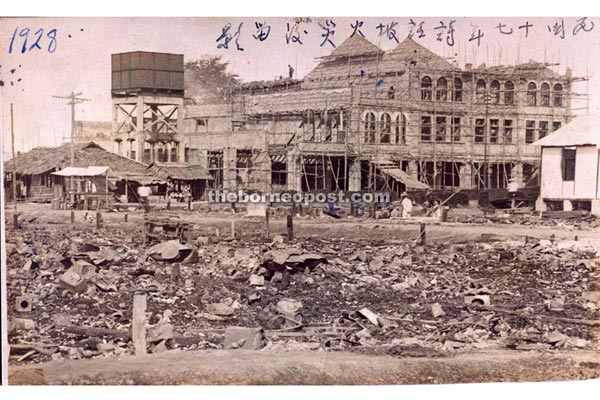
The 1928 Sibu Fire was one of the most devastating urban fires in the early history of Sibu, a riverine town in central Sarawak along the Rajang River.
- The fire broke out in 1928 within the town’s main commercial area, commonly known as Main Bazaar / Channel Road.
- At the time, Sibu consisted largely of closely packed wooden shophouses, many built with timber walls, plank floors, and attap or wooden roofing.
- These construction materials, combined with dry conditions and tightly spaced buildings, allowed the fire to spread extremely rapidly from one structure to another.
Why it became so destructive. Several key factors turned the incident into a major disaster:
- Highly flammable materials
Most buildings were made entirely of wood, making ignition and spread almost instantaneous. - Dense urban layout
Shoplots were built side-by-side with little separation, enabling flames to “jump” across roofs. - Limited firefighting capability
At the time, Sibu had no modern fire brigade system—firefighting relied on buckets, manual pumps, and community effort. - Riverfront wind conditions
Breezes along the Rajang River likely helped carry embers and intensify the blaze.
Extent of Damage
- A large portion of Sibu’s early town center was destroyed.
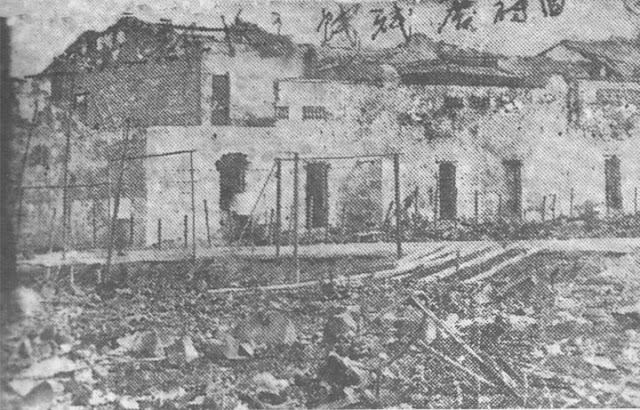
- Entire rows of shophouses were burnt to the ground, leaving behind only charred remains.
- The fire effectively wiped out much of the original wooden settlement.
Human Impact
- Many residents and shopkeepers lost their homes, businesses, and possessions.
- The population at the time included a large number of Foochow settlers, who were central to Sibu’s early development.
- While detailed casualty records are limited, the event caused significant displacement and hardship.
Aftermath & Rebuilding
The fire became a turning point in Sibu’s urban development:
- Reconstruction with improved materials
Buildings were gradually rebuilt using brick and more fire-resistant designs. - Better town planning
Streets and spacing were reconsidered to reduce fire risk. - Foundation for modern Sibu
The disaster accelerated Sibu’s transition from a fragile wooden settlement into a more permanent and structured town.
Historical Significance
The 1928 fire is remembered as:
- One of the most important transformative events in Sibu’s history
- A catalyst for modernization and safer urban construction
- A defining moment in the resilience of early settlers
In Context
Sibu, originally established in the early 1900s by settlers encouraged under the Brooke administration, was still a young and rapidly growing town in 1928.
The fire, though tragic, ultimately shaped the urban identity and layout seen in later decades.
Newspaper Cuttings

https://eresources.nlb.gov.sg/newspapers/digitised/page/maltribune19280412-1.1.2
Sibu Fire – Wooden Built Bazaar Completely Burnt, Four Million Dollars Damage
During the last three years Sarawak this indeed been unfortunate in that no less than five bazaars have been burnt down throughout the country. A disaster of the First order occurred on March 7, when the Sibu bazaar was entirely destroyed by fire between one and four o’clock in the morning. The consequences of this fire were that a very large number of traders were rendered homeless and destitute, says “The Sarawak Gazette.”
Next to Kuching, Sibu bazaar was of course the biggest in the country, and the greatly increased trade of the Rejang River had done much to enhance the value of Sibu as an important trading centre. It is therefore, to be deplored that such a valuable town has been destroyed, but at the same time the fact of the bazaar being constructed entirely of wood was in itself a criterion of its ultimate destruction. From a sanitary point of view, it is possibly the best thing that could have happened. Conditions at Sibu were not desirable and congestion was extremely bad.
The rice supplies after the fire were found to amount to only 300 bags and it WAS necessary that assistance be sent by despatching a cargo of necessities. With this object in view, the s.s. Auby sailed from Kuching in the afternoon of the 7th, and later arrangements were made with Messrs. Paterson, Simons and Co., Ltd., of Singapore, to send a direct shipment of rice by the s.s. Rajah of Sarawak.
The immediate cause of the fire is unknown but it is reported to have originated by the attachment by certain persons of appliances to the electric wires. which were intended to reduce the consumption of current.
The Sibu bazaar was built after the fire of 1889. and was very nearly burnt down in 1902. but was practically saved by Mr. H. L. Owen. who is at present the Resident of that Division, and who was at that time a Cadet. It is gratifying to report that there was no loss of life, and this was very fortunate in view of the fact that not only was the wooden bazaar destroyed, but the brick buildings and piles of coal heaped up at the end of the bazaar for supplying Chinese vessels were also consumed owing to the ferocity of the fire which swept over the buildings such a short time. Owing to the wind having changed to the east, the Malay kampongs were undamaged and the inhabitants are to be congratulated on their good fortune.
It is understood that the total losses and damages amount to approximately four million dollars. At the same time, ever and above these damages, the insurance companies are heavy losers. In conclusion, we can only hope that the new bazaar. which will in course of time be built at Sibu, will be constructed of brick or some other durable material in order that such unfortunate happenings may be needed in the future.
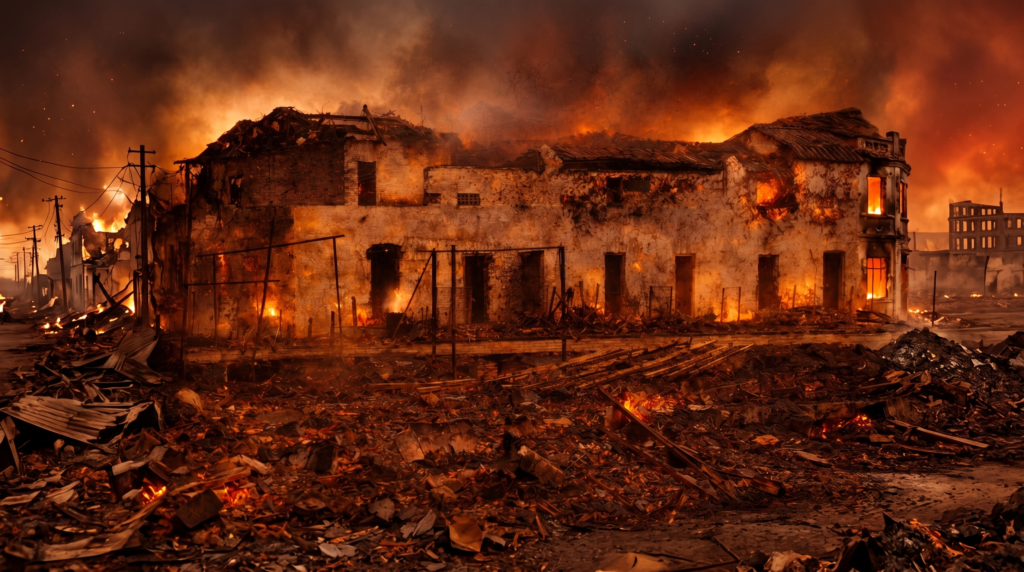
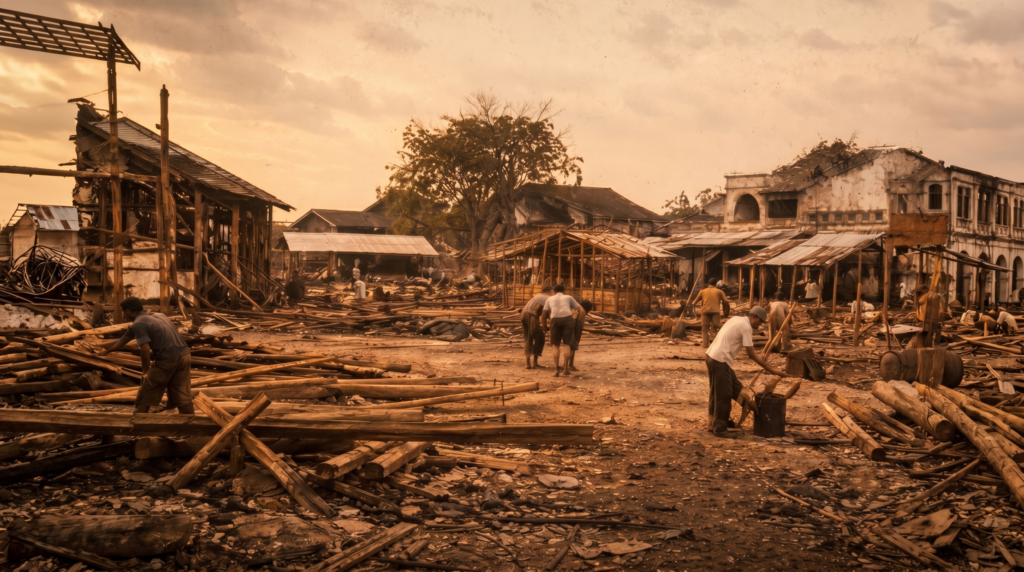
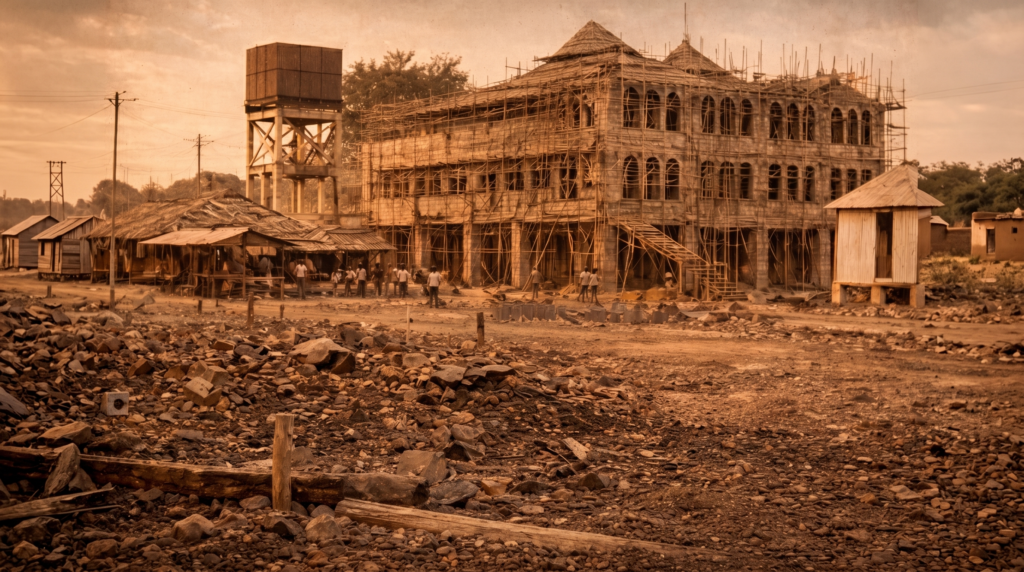
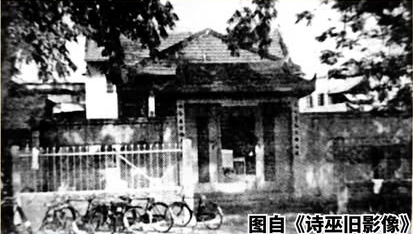
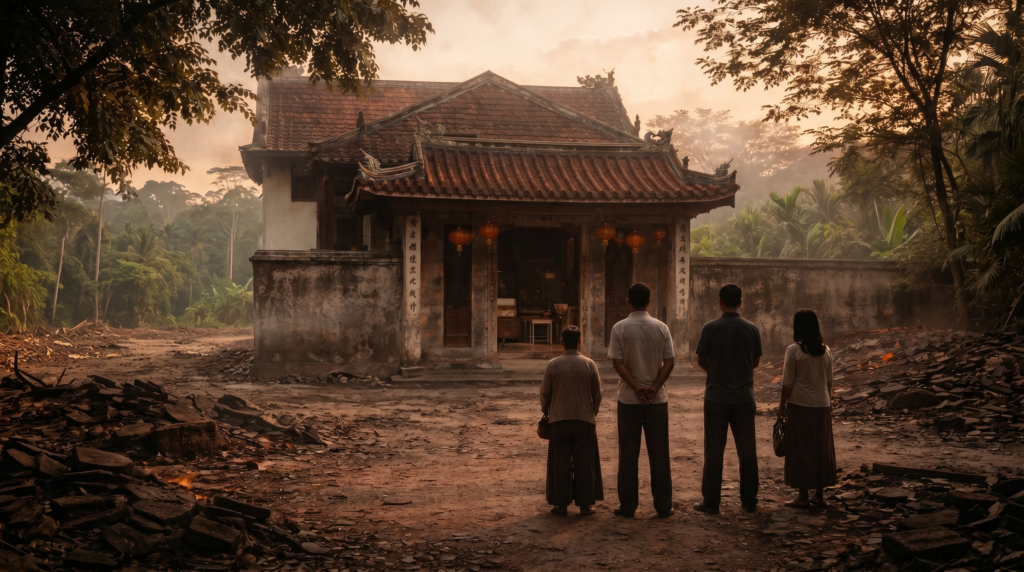
Some of the scenes were created from a single old photos
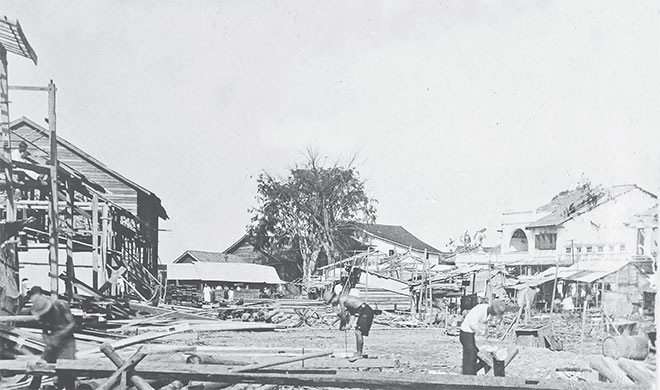
Some of the scenes were restored from old archived photos taken this link
https://sarawakianaii.blogspot.com/2013/07/old-sibu-fire-and-aftermath-in-1928.html
Reported by Sarawak Gazzette – 1st May 2028
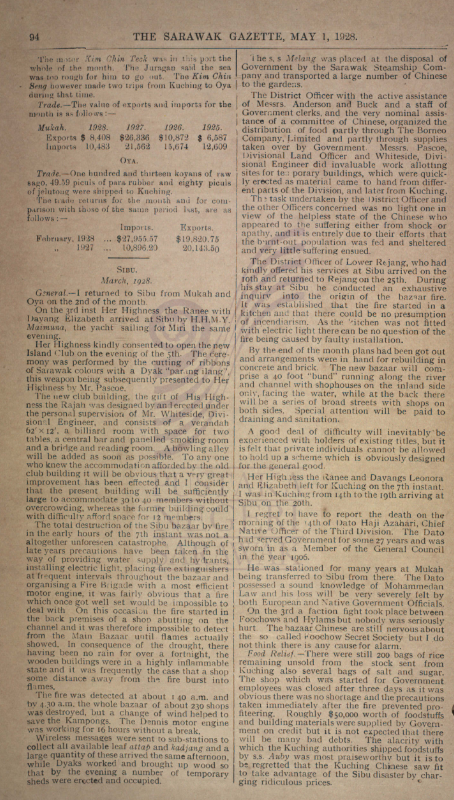
The total destruction of the Sibu bazaar by fire in the early hours of the 7th instant was not a altogether unforeseen catastrophe. Although of
late years precautions have been taken in the way of providing water supply and hydrants. installing electric light, placing fire extinguishers at frequent intervals throughout the bazaar and organising a Fire Brigade with a most efficient
motor engine, it was fairly obvious that a fire which once got well set would be impossible to deal with On this occasion the fire started in the back premises of a shop abutting abutting on the channel and it was therefore impossible to detect
from the Main Bazaar until flames actually showed. In consequence of the drought, there having been no rain for over a fortnight, the wooden buildings were in a highly inflammable state and it was frequently the case that a shop
some distance away from the fire burst into flames
The fire was detected at about 1 40 a.m. and by 4.30 a.m. the whole bazaar of about 230 shops was destroyed, but a change of wind helped to save the Kampongs. The Dennis motor engine was working for 16 hours without a break, Wireless messages were sent to sub-stations to collect all available leaf attap and kadjang and a large quantity of these arrived the same afternoon, while Dyaks worked and brought up wood so that by the evening a number of temporary sheds were erected and occupied.
The s.s Melang was placed at the disposal of Government by the Sarawak Steamship Company and transported a large number of Chinese to the gardens.
The District Officer with the active assistance of Messrs. Anderson and Buck and a staff of Government clerks, and the very nominal assistance of a committee of Chinese, organized the distribution of food partly through The Borneo Company, Limited and partly through supplies taken over by Government. Messrs. Pascoe, Divisional Land Officer and Whiteside, Divisional Engineer did invaluable work allotting sites for temporary buildings, which were quickly erected as material came to hand from different parts of the Division, and later from Kuching.
The task undertaken by the District Officer and the other Officers concerned was no light one in view of the helpless state of the Chinese who appeared to the suffering either from shock or apathy, and it is entirely due to their efforts that the burnt-out population was fed and sheltered and very little suffering ensued.
The District Officer of Lower Rejang, who had kindly offered his services at Sibu arrived on the 10th and returned to Rejang on the 25th. During his stay at Sibu he conducted an exhaustive inquiry into the origin of the bazaar fire.It was established that the fire started in a kitchen and that there could be no presumption of incendiarism. As the ritchen was not fitted with electric light there can be no question of the fire being caused by faulty installation.
By the end of the month plans had been got out and arrangements were in hand for rebuilding in concrete and brick. The new bazaar will comprise a 40 foot “bund” running along the river and channel with shophouses on the inland side only, facing the water, while at the back there will be a series of broad streets with shops on both sides. Special attention will be paid to draining and sanitation.
A good deal of difficulty will inevitably be experienced with holders of existing titles, but it is felt that private individuals cannot be allowed to hold up a scheme which is obviously designed for the general good.
Her Highness the Ranee and Dayangs Leonora and Elizabeth left for Kuching on the 7th instant. I was in Kuching from 14th to the 19th arriving at Sibu on the 20th.
I regret to have to report the death on the morning of the 14th of Dato Haji Azahari, Chief Native Officer of the Third Division. The Dato had served Government for some 27 years and was sworn in as a Member of the General Councilin the year 1906.
He was stationed for many years at Mukah being transferred to Sibu from there. The Dato possessed a sound knowledge of Mohammedan Law and his loss will be very severely felt by both European and Native Government Officials.
On the 3rd a faction fight took place between Foochows and Hylams but nobody was seriously hurt. The bazaar Chinese are still nervous about the so called Foochow Secret Society but I do not think there is is any cause for alarm.
Food Relief -There were still 200 bags of rice remaining unsold from the stock sent from Kuching also several bags of salt and sugar.The shop which was started for Government employees was closed after three days as it was obvious there was no shortage and the precautions taken immediately after the fire prevented profiteering. Roughly $50,000 worth of food stuffs and building materials were supplied by Government on credit but it is not expected that there will be many bad debts. The alacrity with which the Kuching authorities shipped food stuffs by s.s. Auby was most praiseworthy but it is to be regretted that the Kuching Chinese saw fit to take advantage of the Sibu disaster by charging ridiculous prices.
Medical. — During the month 85 patients were admitted into hospital making a total of 106 in all.
749 patients were treated in the Out-patient Department and 106 N.A B. injections given.
It will be noticed that there is a decided increase both in in-patients and out-patients–this I consider is indirectly due to the Sibu fire, all the shops of the local Chinese “doctors” having been burnt, the Chinese had perforce to come to the Government Hospital as also, if they were seriously sick, they more willingly came
as in-patients having no other dwelling to go to.
The actual number of casualties during the fire were four, two of these actually while the fire was raging, and were merely burns of the second degree after the fire had subsided, salvage work was being carried out on one of the remaining brick houses and a coolie fell to the ground from a collapsing first floor, sustaining concussion etc. The fourth casualty occurred to a Chinese who was being brought to hospital from up river. he being delirious, plunged into the red hot ashes before his friends could prevent him, this man died some two-three weeks later.
https://www.pustaka-sarawak.com/gazette/gazette_uploaded/1397633062.pdf